
Feeling like you’re drowning in a sea of toys? It’s a familiar story. One minute you have a lovely, tidy nursery, and the next, it seems every square inch is covered in building bricks, dolls, and half-finished puzzles. But getting on top of it all isn't about finding one magical box. The best toy storage ideas come from creating a system that’s built for your family and your home.
This is your practical guide to creating a playroom that’s actually fun for your kids and, more importantly, manageable for you.
Finding Calm in the Toy Chaos
Let's be honest, an ever-growing toy collection is just part of being a parent. The goal isn't to create a sterile, show-home-perfect room that no one can touch. It’s about creating a functional, inviting space where play can happen easily and tidying up isn’t a monumental battle.
We’re going to get into real-world strategies that I’ve seen work for everything from those tiny, easy-to-lose accessories to the bulkiest playsets. I firmly believe that great storage should be practical, look good in your home, and even encourage the kids to get involved in the clean-up.
Why a Personalised System Is Everything
A one-size-fits-all approach to toy storage almost always fails because every family is different. The big, open baskets that work brilliantly for a toddler's chunky wooden toys will become a chaotic mess for an older child with thousands of tiny LEGO pieces.
Think about these common scenarios:
- The Living Room Play Corner: When the living room is also the playroom, you need storage that’s stylish and discreet. A good practical example is a stylish storage ottoman where soft toys and dress-up clothes can be quickly hidden away, or a side table with deep drawers for board games.
- The Dedicated Playroom: If you’re lucky enough to have a whole room, you can create specific zones for different activities—a cosy reading nook with a forward-facing bookshelf, a craft station with a trolley for pens and paper, and a clear floor space for imaginative play.
- The Shared Bedroom: In a tight space, every centimetre counts. This is where clever vertical and multi-functional storage really comes into its own, like under-bed drawers on wheels for train sets or wall-mounted shelves for displaying favourite figures.
The most effective toy storage is a system that grows and adapts with your child. What holds Duplo bricks today might need to hold art supplies or action figures tomorrow. Flexibility is the key to long-term success.
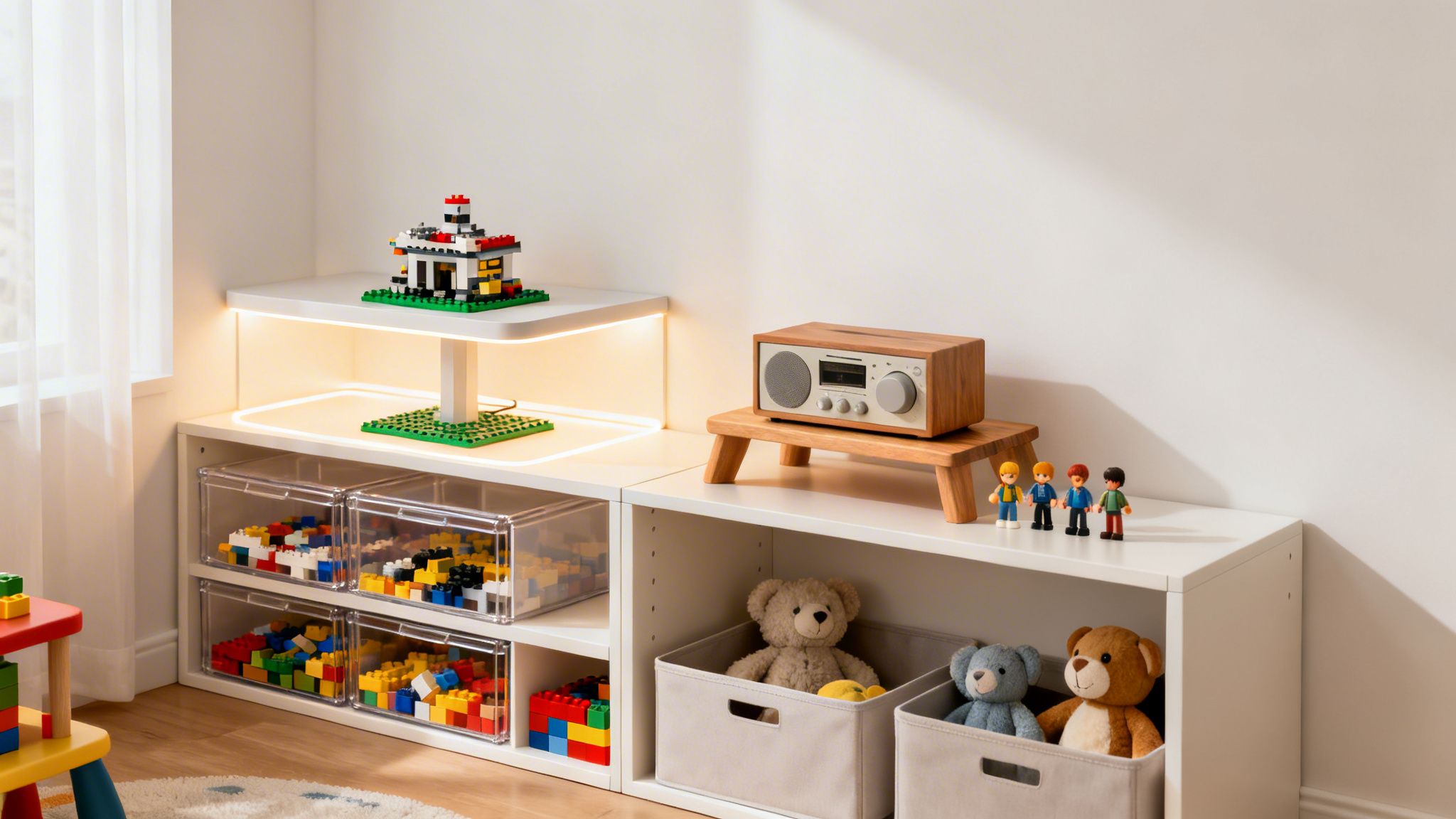
For instance, a parent with a LEGO-obsessed child will quickly learn that a simple toy box just creates a jumble. A much better solution is a display stand with integrated drawers. It lets their child show off their latest creations while keeping all those thousands of spare parts neatly organised.
Likewise, for a family with a Toniebox, a dedicated organiser stand can create a self-contained audio station, which is far better than finding the figures scattered all over the house. You can find more of this kind of practical advice in our complete guide to kids' toy storage solutions.
Ultimately, the best storage ideas bring a sense of order without getting in the way of creativity. By thinking through your specific needs, you can transform that chaotic mountain of toys into a calm, well-organised play environment.
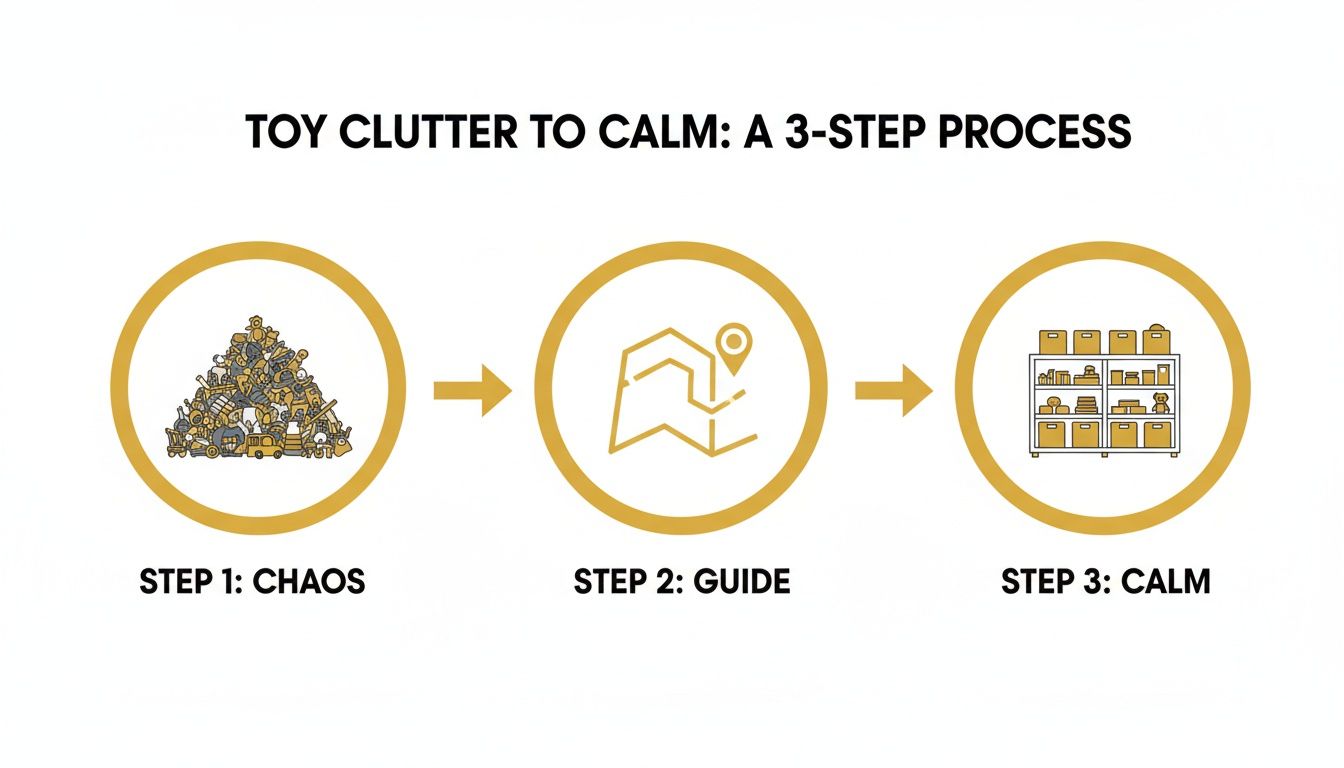
Right, before you even think about buying a single basket or box, let’s talk strategy. I know the temptation to just buy pretty storage is strong, but taking a moment to plan is the single most important thing you can do. A quick audit of what you actually have and where you have space for it will save you from wasting money on solutions that just don’t work for your family.
Think of it as creating a blueprint for a calm, organised home. It’s the foundation for a system that will actually last.
First, A Simple Toy Triage
The first job is to get a handle on what you're dealing with. Yes, this means getting all the toys out. It can feel a bit daunting, I know, but sorting everything into simple groups makes it far less overwhelming. You’ll quickly start to see what your child genuinely loves and which toys are the main culprits behind the clutter.
I find this three-category system works wonders for most families:
- Daily Favourites: These are the superstars, the toys your child reaches for almost every day. For a toddler, this might be their wooden block set; for an older child, their favourite action figures. They need to live in the most accessible, easy-to-reach spots.
- Rotational Play: This pile is for toys that are still loved but don’t need to be out all the time. Think of seasonal toys like buckets and spades, complex board games, or a large train set that has temporarily lost its shine.
- Sentimental Keepers: These are the precious items you want to hang onto but aren't for everyday play. This might be their first teddy, a special gift from a grandparent, or a fragile handmade doll. These are best stored safely on a high shelf or in a dedicated keepsake box.
This initial sort gives you a clear inventory. From here, you can decide what gets prime storage real estate and what can be tucked away in the loft or a wardrobe. It's also the perfect opportunity to weed out any broken toys or things your child has clearly outgrown.
Next, Map Out Your Play Zones
With your toys sorted, it's time to look at your space. Very few of us have a sprawling, dedicated playroom; for most families, play spills out across multiple rooms. Defining your "play zones" is about giving every toy a logical home, which makes tidy-up time a simple matching game instead of a frustrating mystery.
A play zone can be anywhere:
- A designated corner of the living room (e.g., behind the sofa for a play kitchen).
- The floor space in your child’s bedroom (e.g., next to the wardrobe for building bricks).
- A craft area at the kitchen table (e.g., with a nearby trolley for pens and paper).
- A couple of shelves in the hallway (e.g., for library books and puzzles).
Once you’ve identified these zones, you can start matching the toys to the space. It’s common sense, really. A huge collection of building bricks needs a zone with plenty of floor space and dedicated storage. On the other hand, an overflowing book collection in a small bedroom nook is crying out for some clever vertical shelving.
By giving different types of play their own specific zones, you’re not just organising. You're teaching your children how to find what they want and, crucially, showing them exactly where it goes when they're done.
The sheer volume of toys entering our homes makes this so important. The UK toy market, for example, saw a consumption of 223,000 tons in 2024. With most of these being imports, our homes are constantly fighting an influx of new stuff, making smart storage an absolute necessity. Sometimes the best solutions are the ones that blend in, like using personalised 12cm brick letters as both decor and a home for small figures. You can read more about what UK toy market trends mean for families.
Bring It All Together: Your Strategic Plan
Now you can bring your two audits—the toys and the zones—together into one simple, actionable plan. A planner like the one below helps you map everything out before you spend a penny.
Use this template to categorize your toys and map them to specific zones in your home. This makes the decluttering process feel less overwhelming and more strategic.
Your Toy Audit and Zoning Planner
| Toy Category (e.g., Building Bricks, Action Figures, Art Supplies) | Quantity/Volume (e.g., Small, Medium, Large Collection) | Play Zone (e.g., Playroom Floor, Bedroom Shelf, Living Room Cabinet) | Access Level (e.g., Child-led Daily Access, Adult-Supervised) |
|---|---|---|---|
| Building Bricks | Large Collection | Playroom Floor | Child-led Daily Access |
| Art Supplies | Medium Collection | Kitchen Table | Adult-Supervised |
| Tonie Figures | Small Collection | Bedroom Shelf | Child-led Daily Access |
| Board Games | Medium Collection | Living Room Cabinet | Family Access |
With a completed plan like this, you have a clear blueprint. You now know for a fact that you need a large, child-friendly solution for the bricks in the playroom and a compact, neat system for those audio figures on the bedroom shelf. This approach guarantees that every storage purchase you make is a smart one, perfectly matched to how your family actually lives and plays.
Choosing the Right Storage for Every Toy Type
So, you've taken stock of the toy mountain and have a rough idea of where things should live. Now for the fun part: picking out the actual storage. This is where you can really make a difference, moving beyond that one giant toy box where everything ends up in a jumbled mess.
The trick is to think about each toy individually. The right storage makes it easy for kids to play and, just as importantly, easy for them to tidy up afterwards. It's less about finding one perfect bin and more about creating a system that works for each specific type of toy.
Taming the Lego Collection
If you have a young builder at home, you know that bricks like LEGO are in a league of their own. We’ve all felt the unique pain of stepping on a stray piece in the dark. A simple tub just doesn’t work; it turns finding that one crucial piece into a frustrating lucky dip.
An integrated display and storage stand can be a real game-changer here. These units are designed with little builders in mind.
- Display Shelf: The top gives them a proper stage to show off their finished creations. A practical example is having a dedicated shelf for their completed Star Wars spaceship or Hogwarts castle.
- Integrated Drawers: Right underneath, built-in drawers can hold thousands of loose bricks, keeping them contained but still easy to rifle through. For instance, you could use one drawer for red and yellow bricks, and another for blue and green.
- Modular Design: The best ones are modular, meaning you can add more units as the brick collection inevitably grows.
This approach turns tidying up from a chore into part of the creative process. The bricks have a home, your child knows where it is, and your feet are safe.
A Home for Audio Players
Modern audio boxes like the Toniebox or Yoto Player are brilliant for screen-free time, but they come with an entourage of small figures and cards that love to go missing. Just leaving them on a nightstand is asking for trouble.
A dedicated organiser stand creates a neat, self-contained "story station". When looking for one, seek out these features:
- A secure, custom-fit spot for the player itself.
- Tidy cable management for the charging dock (e.g., a small hole at the back to feed the wire through).
- Shelves or magnetic holders made specifically for the Tonie figures or Yoto cards.
This doesn't just protect the player and its accessories; it helps your child become more independent. They can see all their story options at a glance and pick their next adventure all by themselves.
An organised space is an empowering space. When a child can easily find, use, and put away their own toys, it builds their confidence and sense of responsibility. The right storage is a silent teacher.
Solutions for Everything Else
Of course, playrooms are filled with more than just bricks and audio players. The goal is to match the container to the toy’s size, shape, and how often it gets used. A truly well-organised playroom will almost always use a mix of different solutions.
If you're trying to make these ideas work with common furniture, our guide on using storage cubes with IKEA Kallax units is a great place to start.
Bins, Baskets and Boxes
For younger children, open-front bins or low baskets are fantastic. They offer grab-and-go access for bulkier items like building blocks, dress-up clothes, or soft toys. A practical example is having a large, soft basket for all the teddy bears and another for toy cars. With no lid to fiddle with, it’s much simpler for little hands to get things out and, crucially, put them back.
For items with lots of little pieces—puzzles, craft supplies, or dolls with tiny accessories—clear, lidded boxes are essential. For example, keep all the pieces for a farm animal puzzle in one labelled box, and all the doll shoes in another. The lid keeps everything together, while the clear plastic means you can see the contents without opening ten different boxes.
Vertical and Modular Shelving
When you’re short on floor space, the only way to go is up. Wall-mounted shelves are perfect for displaying books, favourite models, or precious items you want to keep out of a toddler’s reach. For example, use a set of floating "picture ledge" shelves to display the covers of their favourite picture books.
Modular shelving, like cube units, gives you incredible flexibility. You can customise them with a mix of drawers, fabric bins, and open shelves to hold almost anything. As your child grows, you can just swap out the inserts to adapt the whole unit. It’s a smart, long-lasting investment.
Designing a Playroom That Encourages Tidiness
Getting the playroom organised is one thing. But creating a space that actually teaches your child how to be tidy? That's the real win. It’s a shift in thinking, moving away from just buying storage boxes and towards designing a whole environment that makes tidying up feel natural.
When putting toys away is just a simple end to playtime, rather than a dreaded chore, you know you've cracked it. The secret is seeing the world from their height. If a child can't reach a shelf, see what's inside a box, or figure out where something goes, we can't really expect them to help keep things in order.
Make It Easy and Obvious
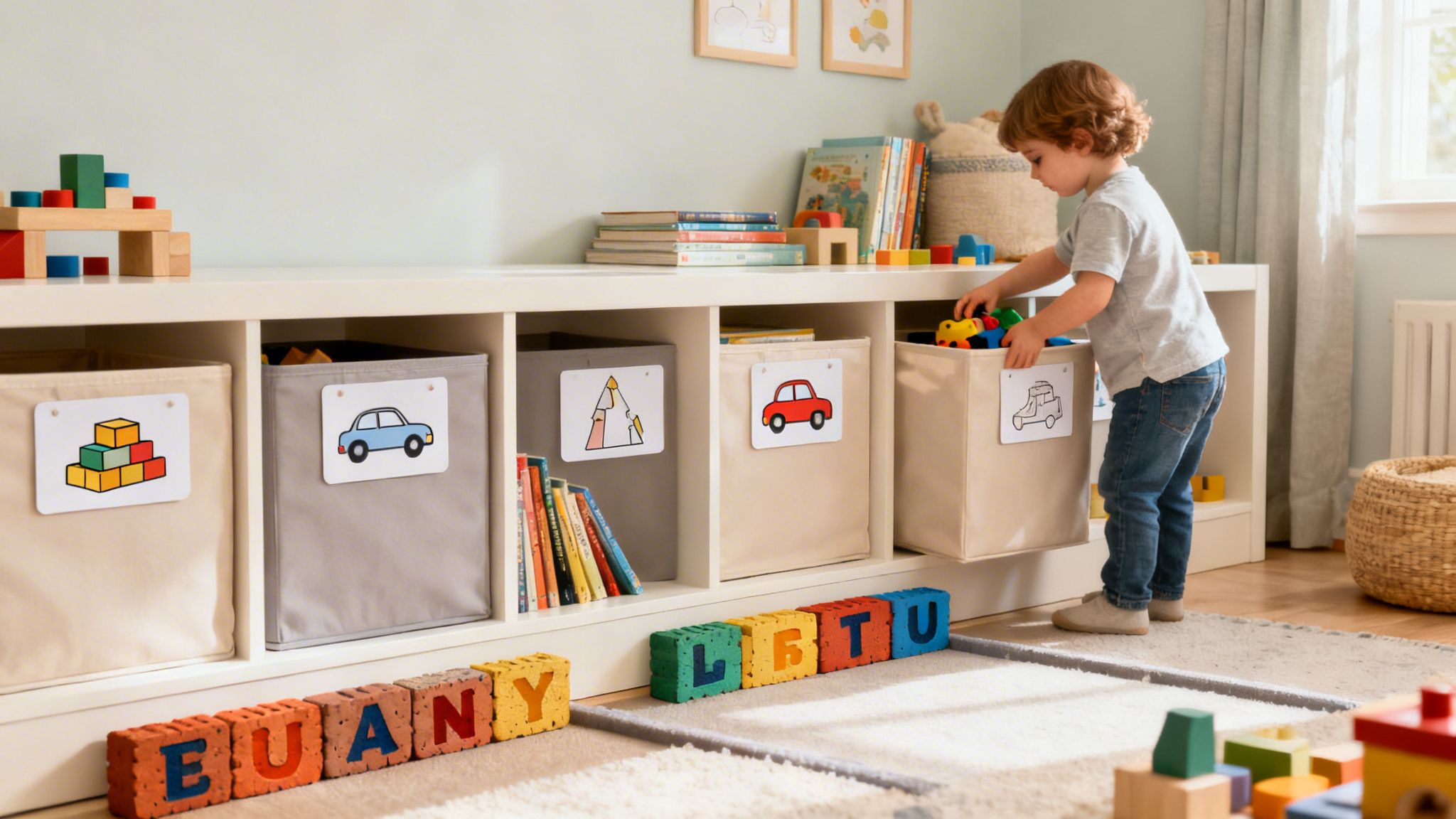
My best piece of advice is always to get down on your hands and knees and see the room from your child’s point of view. Suddenly, you’ll notice that high shelves are useless and deep toy chests are just black holes. Low, open shelving is brilliant because it puts everything at their eye level. They can see what’s on offer, grab it themselves, and—crucially—see exactly where it belongs when playtime is over.
Here are a few things that have worked wonders for parents I've spoken with:
- Picture Labels are Magic: Before they can read, kids respond to visuals. Stick a picture of LEGO on its bin or a drawing of crayons on the art caddy. A practical example is printing a small photo of their toy cars and taping it to the front of the car bin. Suddenly, tidying isn't a chore; it's a fun matching game.
- Keep It Lightweight: Use fabric baskets or bins without heavy lids. A toddler who has to wrestle with a lid is far more likely to just dump the contents on the floor beside it. Easy access is everything.
- A "Home" for Everything: This is a non-negotiable. Just as your cutlery has its own drawer, every type of toy needs a designated spot. For example, the puzzles always go on the bottom shelf, and the dolls always go in the wicker basket. Consistency is what builds habits.
This isn’t about being bossy; it’s about empowering them. Giving them ownership over their space and the skills to manage it is a huge confidence booster.
Turn Tidying into a Game
What if the clean-up was just as much fun as the playing? By choosing clever storage, you can turn the end-of-day tidy into one last game. It’s all about finding solutions that are interactive and playful in their own right.
Take a building brick display stand, for example. It doesn't just store their creations; it invites a child to become a curator of their own little gallery. Tidying the loose bricks into the drawers below is just part of setting up their exhibition. The task is reframed from "put your toys away" to "get your display ready".
When the storage is part of the play, children are so much more willing to engage. A sorting activity is a game; a chore is always a chore.
The same goes for something like an audio player stand. Choosing a story becomes a little ritual. The act of selecting a character like The Gruffalo, listening to the tale, and then placing it back on its magnetic shelf is a complete, satisfying loop. These small design choices make a world of difference. For more inspiration on making the most of your space, have a look at our guide to space-saving toy storage.
Blend Smart Storage with Great Style
Let's be honest, functional storage doesn't have to look purely functional. The best playrooms are the ones where practicality and style work together, creating a space that feels calm for parents but is still exciting for kids.
We’re seeing a huge move towards this. In fact, the market for kids' storage furniture in the UK brought in USD 853.5 million in 2023 alone, and it’s expected to climb to an incredible USD 3,436.0 million by 2030. It shows that parents are actively looking for stylish, multi-purpose pieces that solve the toy clutter problem without sacrificing looks. You can read more about the growth of the UK kids' furniture market on Grand View Research.
Think about how storage can double as decor:
- Zone with Colour: Use different coloured bins or even fun, personalised brick letters to create zones. A practical example: the blue bin for blocks, the red one for cars—it’s a visual cue that also adds a pop of personality.
- Make Shelves a Feature: A rotating bookshelf or an unusual wall shelf shaped like a house can be a real centrepiece, turning books and treasured toys into a beautiful, curated display.
- Add Themed Touches: A light switch surround shaped like a building block or a pen pot that looks like a dinosaur adds a bit of fun while still doing a job. For example, a dinosaur-shaped pot on the art desk can hold all the green and brown colouring pencils.
When you integrate storage into the room’s overall design, you create a seamless, harmonious space. It sends a message to your child that their things are valued and have a proper place, which helps them build respect for their belongings and their home.
How to Maintain Your Organised Space for the Long Haul
Getting the playroom organised feels like a huge win, but let’s be honest, the real work is keeping it that way. The good news? It doesn’t have to be a constant battle. It’s all about weaving simple habits into your family's daily life that make tidiness second nature.Think of your organised space not as a finished project, but as a living system. It just needs a little regular attention to keep it from spiralling back into chaos. With the right routines, you can stop the clutter from creeping back in for good.
The Power of Daily Routines and Rotations
Consistency beats intensity every single time. You don't need to dedicate an hour every night to a massive overhaul. Small, regular tidy-ups have a much bigger impact and prevent burnout for everyone.
My favourite trick is the 10-minute family tidy-up. A practical example is to stick on a fun song like "Baby Shark" and challenge everyone to put away as much as they can before it ends. This simple switch turns a chore into a quick game and stops the mess from building into an overwhelming mountain.
Another game-changer is seasonal toy rotation.
- Keep Play Fresh: Pack away about half the toys into boxes and tuck them away in the loft or a cupboard. For example, in winter, store the paddling pool and summer toys, and bring out the indoor craft sets and complex board games.
- Reduce Clutter Instantly: Fewer toys out at once means the room instantly feels less crowded and is far easier to clean.
- Boost Engagement: When toys reappear after a break, they feel brand new. This simple trick sparks renewed interest and encourages deeper, more imaginative play.
This approach not only makes daily tidying easier but also gives you a clear picture of which toys are true favourites and which ones are ready to be passed on.
Adopt the 'One In, One Out' Rule
To prevent your beautifully organised shelves and bins from overflowing, the "one in, one out" rule is your best friend. The idea is wonderfully simple: for every new toy that comes into the house, one old toy has to go. This becomes especially important after birthdays and Christmas.
The 'one in, one out' rule isn't about being mean; it's about teaching conscious consumption. It helps children realise that space is limited and encourages them to think about what they truly value.
A practical way to implement this: after a birthday, sit down with your child and their new toys. Ask them, "To make space for this amazing new playset, which older toy are you ready to give to another child who would love to play with it?" Get your child involved by asking them to choose which toy they’re ready to donate to a new home.
Evolving Your Storage as Your Child Grows
Let's face it, the storage system that was perfect for your toddler’s chunky blocks is not going to work for your eight-year-old’s detailed model kits. To stay effective, your storage has to be able to adapt.
This is where modular and multi-functional storage really proves its worth. A simple cube shelving unit, for example, can grow right alongside your child.
- Ages 1-3: Use open fabric bins that are perfect for little hands to grab soft toys and Duplo.
- Ages 4-7: Swap some bins for drawers to contain runaway craft supplies and small action figures. Add a Toniebox organiser stand to create a dedicated audio story station.
- Ages 8+: Introduce shelf inserts to proudly display finished LEGO models or to organise chapter books. For instance, a clear acrylic insert can turn one cube into a two-level display case for prized Hot Wheels cars.
Choosing adaptable pieces from the start saves you so much time and money in the long run. Instead of buying entirely new furniture every few years, you can just reconfigure what you already own, ensuring your system works just as hard for you five years from now as it does today.
Your Common Toy Storage Questions Answered
Even with the best-laid plans, a few tricky questions always seem to pop up when you're trying to tame the toy chaos. I get asked these all the time, so let's walk through some practical answers to the most common storage dilemmas.
What Is the Best Way to Store LEGO Without Losing All the Small Pieces?
The nightmare of stepping on a stray LEGO brick is real. I've found the best way to manage them is to make storage part of the play. A practical example is a large play mat that cinches up into a bag, which is fantastic for keeping everything contained during those big building sessions on the floor.
For a more permanent solution that looks great, integrated systems are the way to go. We love modular building brick display stands that give kids a place of honour to show off their finished models. The really clever ones have built-in drawers underneath that can hold thousands of loose bricks. This turns tidying up into a satisfying final step and finally ends the desperate hunt for that one tiny, crucial piece.
How Do I Organise a Toniebox and All Its Figures?
A dedicated stand is an absolute game-changer for audio players and their ever-expanding army of characters. When you're picking one, there are a few features that make all the difference.
A great organiser should have:
- A secure, designated spot for the Toniebox itself.
- A neat home for the charging station (e.g., a custom-cut hole for the circular charger).
- Custom-fit shelves or magnetic strips for all the figures.
This setup creates an inviting little "audio station" that genuinely encourages independent play. Your child can easily see all their story options and pick their next adventure, keeping everything in one place and protecting those delicate figures from getting lost or broken.
The goal is to make tidiness intuitive. When the storage solution is so simple and visual that a child can use it without thinking, you've created a system that will last.
This approach doesn't just clear up a messy corner; it transforms it into a self-contained activity hub. It gives the toys a clear home and empowers your little one to manage their own playtime from start to finish.
How Do I Get My Toddler to Help Tidy Up Their Toys?
Ah, the million-dollar question. The secret to getting toddlers to actually help clean up is to make it visual, simple, and completely accessible from their level. Think low, open-fronted bins where they can see exactly what goes inside without needing any help from you.
Try labelling each bin with a picture of the toys that belong in it—a photo of their blocks on the block bin, for example. Suddenly, tidying up becomes a fun matching game instead of a chore. Most importantly, make sure everything is at their height. A child can't put something away if they can't reach the shelf or open the lid. Lightweight baskets with handles are perfect for this, as they empower toddlers to take real ownership of their space.
What Are Some Good Toy Storage Ideas for a Small Living Room?
When your living room doubles as a playroom, the best toy storage is storage that goes undercover. Multi-functional furniture is your greatest ally here.
Think about pieces that can do double duty:
- A stylish storage ottoman for a quick-hideaway spot for soft toys and blankets.
- A side table with surprisingly deep drawers for board games and puzzles.
- Cube shelving with fabric bins that match your living room’s colour scheme, hiding everything from train tracks to dolls.
These solutions let you reclaim your adult space in just a few minutes before guests arrive. Vertical storage also works wonders in tight spots. A slim, wall-mounted display shelf for a few treasured toys can add a playful, personal touch without stealing any precious floor space, blending your child’s world with yours seamlessly.
Ready to find the perfect pieces to calm the chaos? At TidyCubs, we design and make personalised, practical solutions right here in the UK that grow with your family. Explore our range of organisers and decor to create a playroom you'll all love.