
Staring at a mountain of toys, it’s easy to feel like you’re losing the battle. But what if the secret to a calmer, more creative home isn't about having fewer toys, but simply finding the right homes for them? The best playroom storage ideas do more than just hide the clutter; they make tidying up a natural, stress-free part of playtime itself.
Conquering Toy Chaos in Your Home
If a room bursting with toys feels chaotic to you, imagine how it feels for a little one. It’s not just a visual mess—cluttered spaces can be genuinely stressful for parents and children alike. In fact, research shows 40% of parents point to clutter as a major source of stress at home. The real goal isn't to make the toys disappear, but to create an environment where children can play more deeply and families can feel more relaxed.
Think of this guide as your game plan for taking back your space. We'll walk through practical, stylish ideas that actually work, helping your children become more independent and making clean-up time a team effort instead of a chore.
Getting your toy storage right brings some brilliant benefits:
- Sparks Independent Play: When kids can easily see and grab their own toys, they’re far more likely to start playing without you. For example, a low shelf with building blocks just waiting to be turned into a castle means they don't need a grown-up to get things started.
- Cuts Down on Overwhelm: Faced with a giant, jumbled toy box, it’s hard for a child to decide what to do. A smaller, well-organised selection—like having just the animal figures and a basket of magnetic tiles available—helps them focus, leading to more imaginative and engaged play.
- Builds Good Habits: Giving everything a "home"—a specific basket for cars, a shelf for puzzles—is a simple but powerful concept. For example, your child quickly learns that the red bin is for DUPLO. This gives them a clear map for tidying up and teaches them a life skill without it feeling like a lecture.
As a family-run business right here in the UK, we've navigated our own fair share of LEGO minefields and runaway dolls. At TidyCubs, the solutions we design come from real-world experience with our own 'little cubs,' so we know what modern families need. Whether you have a whole playroom or just a corner of the living room, you can discover fantastic kids' toy storage solutions that finally bring the fun and function together.
Creating Smart Zones for Better Play
The real secret to a playroom that actually stays tidy isn't just buying more storage bins—it’s all about creating a smart layout. Think of it like your kitchen: you keep all your baking supplies together and your pots and pans near the hob. When we apply that same logic to a playroom, it's called zoning, and it’s the key to turning chaos into a space that genuinely works for your child.
This approach is simple: you create dedicated areas for different kinds of play. By giving every activity its own "home," you not only cut down on mess but also help your child focus and make tidying up feel less like a chore. It becomes second nature for them to understand that LEGO belongs in the building area and crayons stay in the art corner.
This little flowchart shows exactly how a bit of strategic organisation can completely change the feel of a room, taking it from chaotic to calm.
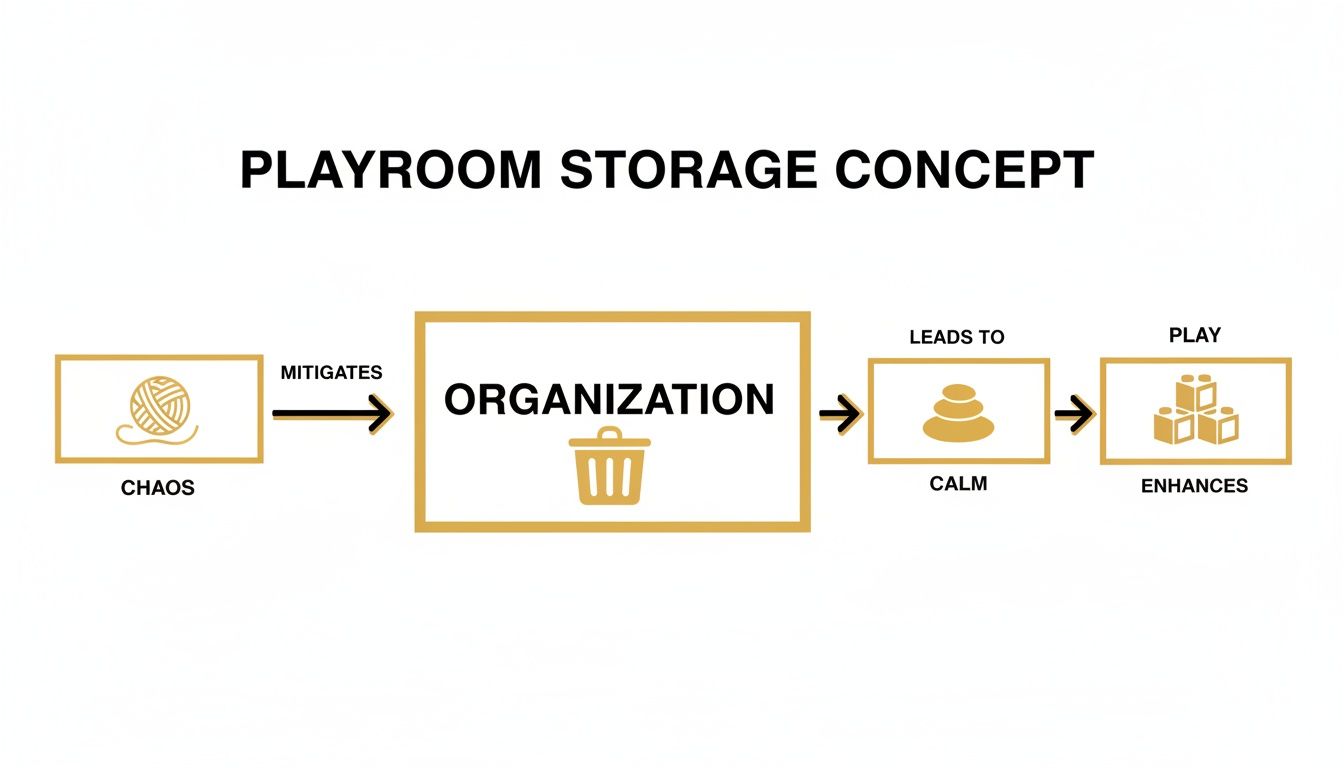
As you can see, once you have a system in place, the room shifts from overwhelming clutter to a much calmer state. It’s in that calm that deeper, more imaginative play can really flourish. That’s the whole goal of thoughtful playroom design.
How to Map Out Your Play Zones
Before you even think about buying a single storage cube, grab a pen and paper. Sketch a rough floor plan of the room, noting where the windows are, where the door is, and how your child naturally moves around the space.
Next, jot down the main types of play your child loves. Most playrooms thrive with a few core zones:
- The Quiet Zone: This is the spot for reading books and figuring out puzzles. It’s best tucked into a cosy, well-lit corner, away from the main hustle and bustle. A practical example would be placing a soft sheepskin rug, a couple of beanbags, and a forward-facing bookshelf here to create an inviting little nook.
- The Building Zone: Home to all things LEGO, blocks, and train sets. This zone needs plenty of open floor space, so an area with a durable rug or play mat is ideal. For example, you could have a low-pile rug where they have enough room to spread out and build an entire city.
- The Creative Zone: This is where the arts and crafts magic happens. Try to place this near a window for good natural light and, if you can, on a hard floor that’s easy to wipe clean. A small table with a roll of craft paper attached and chairs with storage pots for pens and paints nearby is a must.
- The Imaginative Zone: For dress-up, dolls' houses, and pretend play. A corner kitted out with a costume rail, a play kitchen, or a doll's house works perfectly. A practical example is adding a full-length, shatterproof mirror on the wall so they can see themselves dressed as a superhero or a princess, which really brings their characters to life.
A well-zoned playroom doesn’t just organise toys; it helps children learn to focus and manage their own play. Research even suggests that children in organised environments are 25% more likely to stick with a task and manage their behaviour.
Defining Zones with Furniture and Decor
Once you have your map, you can use furniture and decor to create visual boundaries for each zone. You don’t need to put up walls—subtle cues are incredibly effective. A practical example is using a colourful rug to signal the edge of the building zone, while a child-sized table and chairs clearly says, "This is the art station."
Modular storage, like the units from TidyCubs, is brilliant for this. For instance, you could use a low two-by-two cube unit to act as a soft barrier between a quiet reading nook and a more boisterous play area, giving you both storage and a physical divider in one.
It’s no surprise that families are looking for these kinds of clever solutions. The kids' storage furniture market in Europe is growing fast, with the UK market alone expected to expand at a 16.7% CAGR through 2028. This makes perfect sense when you consider that 25% of UK families live in terraced homes where every square foot counts. You can learn more about this trend by reading up on the Europe kids' storage furniture market. Ultimately, these smart playroom storage ideas are all part of a bigger shift towards creating family homes that feel calm, organised, and joyful.
Choosing the Right Storage for Your Toys
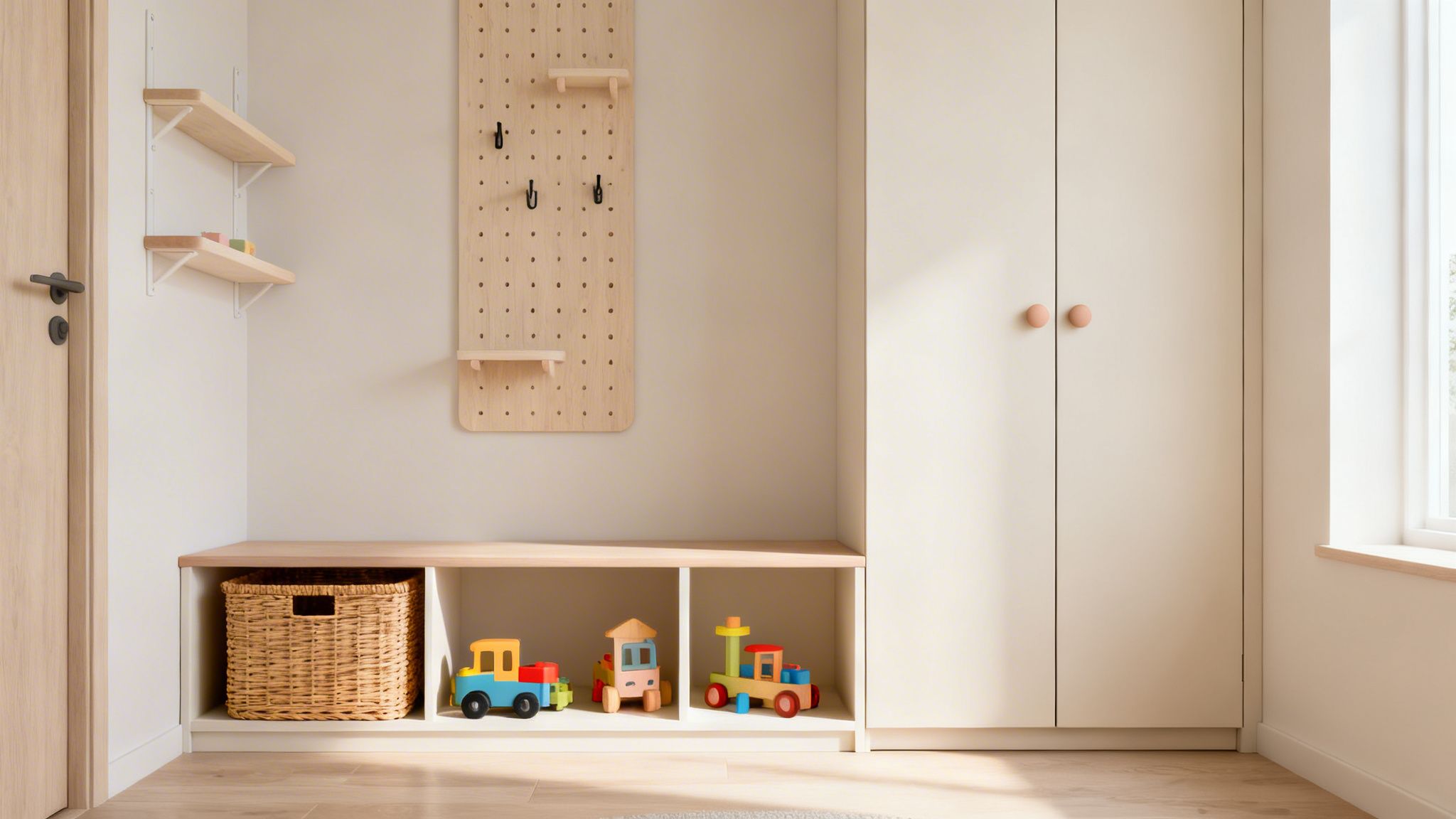
Now that you’ve mapped out your play zones, it’s time to pick the actual storage. This isn't just about making the room look nice; it's about creating a system that works for your child and, just as importantly, for you. The two main players here are open and closed storage, and the real magic happens when you get them working together.
Think of open storage—like low shelves or forward-facing bookcases—as the shop window for your child's toys. It puts their favourite things on display, inviting them to grab what they want without having to ask. For example, a shelf displaying a beautiful wooden farm set encourages them to play. This is brilliant for encouraging independence and sparking self-led play.
Then you have closed storage, your secret weapon against the inevitable chaos. Baskets, cupboards, and deep drawers are lifesavers for hiding those mountains of tiny pieces or the visually 'busy' toys. A practical example is sweeping all the plastic figurines into a bin and sliding it into a cube unit at the end of the day. Pure bliss!
Open vs Closed Storage: Which Is Right for Your Toys?
Deciding between open and closed storage isn't an either/or dilemma. The most successful playrooms use a smart combination of both, tailored to the specific toys and how your child plays with them. This creates a space that’s easy for them to navigate and even easier for you to keep organised.
The table below breaks down which storage type works best for different categories of toys, helping you make the right choice for every item in your collection.
| Toy Category | Best Storage Type | Why It Works | Practical Example |
|---|---|---|---|
| Building Bricks (LEGO, DUPLO) | Closed | Hides visual clutter and keeps thousands of small, mismatched pieces contained. | Large, deep Trofast-style bins or drawers. |
| Beautiful Wooden Toys & Puzzles | Open | Showcases aesthetically pleasing toys, turning them into room décor. | A low Kallax-style shelf. |
| Books | Open (Forward-Facing) | Allows toddlers to see the covers, encouraging them to pick a story. | Wall-mounted Mosslanda picture ledges. |
| Arts & Crafts Supplies | Both | Open for easy access to paper/crayons; Closed for messy items like paint/glitter. | A mix of open pots on a desk and lidded boxes in a cupboard. |
| Dressing-Up Clothes | Both | A rail for costumes (open) and a trunk for hats, wands, and accessories (closed). | A small clothing rail next to a large wicker basket. |
| Action Figures & Small Dolls | Open (Display) | Turns collections into a feature and makes characters easy to find. | TidyCubs Character Shelves. |
By mixing and matching, you get the best of both worlds. Beautiful puzzles and books can be displayed on open shelves, while the chaotic jumble of dressing-up clothes and LEGO bricks are neatly tucked away in closed bins. It's a simple strategy used in many popular systems, and for more inspiration on blending units, check out our guide to customising IKEA Trofast storage, a go-to for countless families.
Going Vertical with Your Storage Ideas
In many UK homes, floor space is gold dust. When you can’t build outwards, the only way is up. Thinking vertically is a game-changer for smaller playrooms, allowing you to claw back that precious floor area for what it's truly meant for—play!
Look at the unused wall space above chests of drawers or toy boxes. A simple set of floating shelves can be perfect for displaying finished models or storing items in pretty baskets. Pegboards are another fantastic and flexible option. For a practical example, use a pegboard to hang small pots of pencils, craft supplies, and even small toys like scissors or tape.
By thinking vertically, you reclaim valuable floor space for what it’s meant for—play. A tall, narrow bookshelf can hold just as many toys as a wide, bulky unit but takes up half the footprint.
This is where purpose-built solutions really come into their own. For example, the TidyCubs building brick displays are designed to be wall-mounted, turning your child’s proudest creations into wall art while keeping them safely off the floor. Our Toniebox stands and character shelves do a similar job, getting the entire audio system neatly organised on the wall and freeing up surfaces below. It’s the perfect way to blend fun and function.
Implementing a Toy Rotation System
If you feel like you’re drowning in a sea of toys, you're not alone. It's a common battle for parents, but one of the most powerful playroom storage ideas isn’t about finding more space—it’s about having less stuff out. This is where a toy rotation system completely changes the game.
The idea is wonderfully simple. Think of your toy collection as a mini-library. A good library doesn’t put every single book on display; it curates what’s on show to make discovering something new and exciting much easier. A toy rotation does the same thing for your playroom. You choose a small selection of toys to have out and pack the rest away. When it’s time to swap, the toys coming out of storage feel brand new again.
Not only does this instantly reduce clutter and make tidying up a breeze, but it also has a profound impact on how children play. I've seen it time and time again: when faced with fewer choices, kids are less likely to flit from one thing to the next. Instead, they dig in, engage more deeply, and get far more creative. It's a win for a calmer home and a win for your child's focus and imagination.
Step 1: The Great Toy Audit
Before you can rotate anything, you need to know what you’re working with. The first step is a big sort-out. Gather every toy from every corner of the house and pile them all in one place. Seeing the sheer volume can be a shock, but it’s a necessary one.
With your toy mountain assembled, it’s time to sort everything into three piles:
- Keep: These are the clear winners—the toys your child genuinely loves and returns to again and again. Think open-ended classics like building blocks, art supplies, and favourite character figures.
- Donate or Sell: This is for anything in good condition that's been outgrown or is simply ignored. For example, that shape sorter they mastered a year ago.
- Bin: Be ruthless here. Anything broken, missing essential pieces, or just beyond saving has to go. Think puzzles with missing pieces or cars with broken wheels.
Depending on their age, getting your child involved can be a brilliant lesson in letting go and helping others. You could frame it as making room for new adventures, saying something like, "Let's find some toys for the charity shop so another child can have fun with them, just like you did."
Step 2: Curate Your Toy Library
Now, turn your attention to the 'Keep' pile. This is the foundation of what I like to call your toy library. The aim isn't to hide toys, but to organise them into curated, manageable collections. You’ll create several themed or balanced boxes, with only one box's worth of toys available at any given time.
A good starting point is to have around 10-20 toys out at once, though you can adjust this based on your child's age and the size of your playroom. The key is to make sure each rotation box offers a nice variety. For example, a single box might contain:
- Something to build (e.g., a small set of LEGO, magnetic tiles)
- Something for imaginative play (e.g., dress-up clothes, animal figures)
- A puzzle or a logic game (e.g., a 24-piece jigsaw)
- A couple of dolls or vehicles (e.g., two favourite Barbies or a few Hot Wheels cars)
- A small selection of art supplies (e.g., crayons and plain paper)
Store the out-of-rotation boxes somewhere out of sight and out of mind—a loft, the garage, or the top of a wardrobe works perfectly. Using large, opaque storage totes is a great practical example, as your child can't see what's inside. This is crucial for creating that "wow, new toys!" feeling.
Step 3: Find Your Rotation Rhythm
So, how often should you swap the toys over? There isn't a magic number; it really comes down to your child. Some families find a fresh rotation every two weeks is the sweet spot, while for others, a month works better. The best thing to do is watch for the cues. If your child seems bored, restless, or isn't really engaging with what's out, it's probably time for a swap.
Most importantly, be flexible. A practical example: if your little one is halfway through building an epic train track that spans the entire living room, don't pack it away just because your calendar says so. The system is meant to work for you, not the other way around. By adopting this simple 'library' approach, you’ll quickly discover your playroom stays tidier and your child's play becomes richer and more inventive than ever.
Smart Storage for Collectable Toys
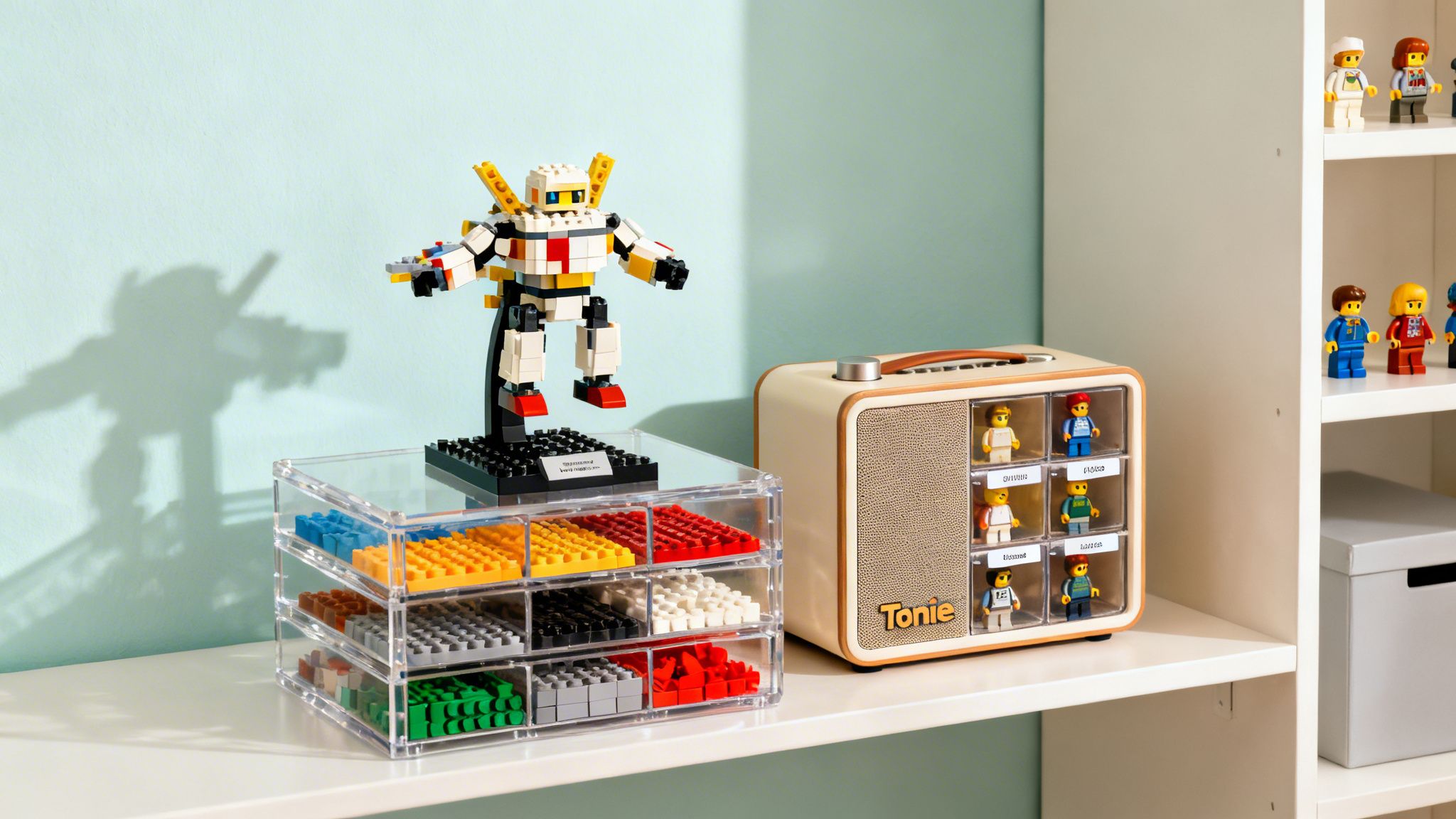
Even with the best zoning and rotation systems, some toys just refuse to be tamed. We're talking about the collectables, the ones that come with a million tiny, essential pieces. I’m sure you know the ones I mean. LEGO and Tonies are brilliant for sparking creativity, but they bring their own unique brand of chaos.
How on earth do you stop a tidal wave of bricks from covering every inch of floor? And where do you put all those little Tonie characters so they don’t vanish into thin air? This is where a generic toy box just won't cut it. These collections need their own specialised systems that make them easy to play with and easy to put away.
Taming the Building Brick Mountain
LEGO is a childhood staple, but every parent lives in fear of that sharp, sudden pain of stepping on a stray brick. The sheer number of pieces can feel completely overwhelming. The secret isn't just to hide them away, but to strike a balance between easy access for building and a quick, painless tidy-up.
I've found the most effective method is a two-part system: a space for display and a place for deep storage.
-
Display for Creations: Kids are so proud of what they build, and they should be! Giving their finished models a place of honour on a dedicated shelf, like one of TidyCubs' wall-mounted building brick stands, shows you value their work. It also has the very practical benefit of keeping that delicate Star Wars X-wing safe from being knocked over.
-
Sorted Deep Storage: For all those thousands of loose bricks, sorting is your best friend. Sorting by colour looks pretty, but trust me, sorting by type (all 2x4 bricks together, all wheels in one tub) is far more practical. It makes finding that one specific piece for a new masterpiece so much faster. A great practical example is using clear, stackable hardware drawers from a DIY store, so your little builder can see everything at a glance.
This approach stops that frustrating, endless rummaging through one giant tub of mixed-up pieces. It transforms a potential source of frustration into a smooth, creative process.
Organising Your Audio Story Collection
The Toniebox is another modern favourite that can quickly get out of hand. That ever-growing cast of Tonie characters is small, precious, and incredibly easy to misplace. Before you know it, they're scattered across floors, stuffed down the side of the sofa, or lost in the bottom of a toy box.
A purpose-built organiser makes a world of difference here. A practical example is a dedicated stand that creates a ‘home base’ for the Toniebox and its charger, while providing magnetic shelves or individual slots for each and every character. Everything is kept together, neat, and visible. Your child can easily see all their options—from Peter Rabbit to The Gruffalo—and choose the story they want without tipping everything out.
Giving collectables a dedicated 'home' is a key part of smart playroom storage ideas. It prevents small, valuable pieces from getting lost and teaches children to care for their special collections, turning tidying into an act of preservation rather than a chore.
It’s no surprise that parents are actively looking for these kinds of solutions. The UK kids storage furniture market hit an incredible USD 853.5 million in 2023, a figure that's expected to climb as more families seek out tidy, functional play areas. You can see how specialised furniture like bookshelves, which held the largest market share, contribute to creating organised and playful homes for UK families. If you’re just starting your audio story adventure, we also have a great guide on what to expect from a Toniebox starter set and how to keep it organised from day one.
Where Safety and Style Meet
An organised playroom is a calm one, but before we even think about aesthetics, we have to talk about safety. They aren't separate goals. The very best playroom storage ideas are the ones that are rock-solid and secure, while also looking fantastic and inspiring the little ones who use them every day.
It's no surprise that parents are zeroing in on this. The demand for great toy storage is booming, with the UK market projected to grow at 6.2% CAGR between 2025 and 2035. Why? Because families are tired of clutter and are prioritising safer, more organised living. When you consider that UK parents spent an average of £150 per child on toys by 2023, the need for smart, child-friendly storage becomes crystal clear. It's not just about tidiness; many parents will tell you that a well-organised space can slash trip hazards by as much as 30%. As regulations push for non-toxic and recyclable materials, the market is thankfully following suit. You can get a deeper look into the trends shaping the toy storage market at Future Market Insights.
The Non-Negotiable Safety Checklist
Before you fall in love with a colour scheme, let's run through the absolute must-dos. Getting these fundamentals right gives you the peace of mind to then get creative with the fun stuff.
- Anchor Everything: Any tall or heavy furniture—bookshelves, chests of drawers, you name it—has to be securely anchored to the wall. For example, all IKEA furniture comes with anchoring kits for this very reason. This is the single most important thing you can do to prevent a dangerous tipping accident.
- Go for Non-Toxic Materials: Little ones explore the world with their hands and, let's be honest, their mouths. Always choose storage made from non-toxic, child-safe materials and paints. For instance, look for certifications like FSC for wood and water-based paints.
- Soften the Edges: Sharp corners are just asking for trouble during a bout of energetic play. Opt for furniture with rounded or softened edges to minimise the risk of bumps and scrapes. You can also buy soft corner protectors to add to existing furniture.
- Think About Little Fingers: A heavy, slamming toy box lid is a major hazard. The best solutions are often lid-free, like open bins and baskets. If you do go for a box with a lid, make sure it has soft-close hinges or a safety gap to prevent it from trapping tiny fingers. A classic wooden toy chest with a slow-closing lid is a great example.
Remember, safety isn’t a one-and-done job. Get into the habit of regularly checking your storage units for wobbly legs, loose screws, or splintering wood to keep the playroom a true safe haven.
Weaving Storage into Your Decor
With the safety basics covered, we can get to the fun part: making your storage a key player in the room's design. Storage shouldn't be an ugly necessity you try to hide away. When done right, it can be a beautiful feature that ties the whole space together.
Colour is your best friend here. Instead of just defaulting to plain white or wood, think about how colourful bins and shelves can set the tone. For a practical example, you could go for a cheerful rainbow effect using different coloured bins in a white cube unit, a calming pastel palette for a nursery, or bold primary colours to match a superhero theme. It's easier than ever to find the perfect shade—TidyCubs, for example, offers over 20 different colour options, so you can easily match everything to a dinosaur-themed den or a magical unicorn kingdom.
Making It Theirs with a Personal Touch
The final layer is what turns a tidy room into their room. Personal touches give children a real sense of ownership, which often encourages them to take pride in their space and actually help keep it organised.
Think about labelling. Sure, it’s a practical trick for knowing what goes where, but it can also be stylish and personal. A great example is using custom-made brick letters to spell out "LEGO," "Cars," or "Dolls" on the front of bins. You could even use them to spell out your child's name and mount it on the wall above their storage unit. Suddenly, a simple organisational system becomes a stunning, personal focal point. It’s the perfect blend of function and personality.
Common Questions About Playroom Storage
Even with the best-laid plans, the reality of keeping a playroom organised can throw up a few curveballs. Let’s walk through some of the most common hurdles parents run into and find some practical, real-world answers to get your space back on track.
How Do I Get My Child to Tidy Up?
Ah, the million-dollar question! Designing a brilliant storage system is one thing, but getting your little one to actually use it can feel like the final boss battle. The trick isn't nagging or endless reminders; it's making tidying up feel like part of the play.
- Show, Don't Tell: For little ones who can't read yet, visual cues are everything. A practical example is to stick a photo of the LEGO on its designated box or a drawing of their cars on the front of the right drawer. They'll know exactly where things belong without having to ask.
- Keep It Within Reach: If they have to climb or ask for help to get a toy, they'll never be able to put it away themselves. For instance, their favourite, most-played-with toys should live on low, open shelves they can easily access, no higher than their shoulder height.
- Make It a Beat: Turn cleaning into a mini-ritual. Put on a "tidy-up song"—like the one from Barney or Cocomelon—for a fast and fun five-minute blitz before dinner or bed. When it becomes a predictable part of the day, you'll find there’s far less resistance.
Remember to get them involved from the start. If they help you choose the colourful bins or decide where the dinosaurs should "sleep," they'll feel a real sense of pride and ownership over their tidy space.
What Are the Best Ideas for a Small Playroom?
When you’re short on square footage, you have to think smart and get creative. Your two best strategies are to go vertical and to choose furniture that does more than one job. This lets you carve out maximum storage without eating into that precious floor space needed for play.
In a compact room, every single item needs to earn its keep. A great practical example is an ottoman with hidden storage—it’s not just a seat, it’s a treasure chest for dress-up clothes. A play table with built-in drawers becomes an art station and a home for pens and paper all in one.
Look up! Tall, slim shelving units are fantastic for drawing the eye upwards and making use of wall space that would otherwise go to waste. Wall-mounted shelves and pegboards are also brilliant for getting books, craft supplies, and small toys off the floor. And honestly, a toy rotation system is non-negotiable in a small room; it’s the single best way to stop the space from feeling cluttered and overwhelming.
How Can I Organise on a Tight Budget?
You absolutely do not need a massive budget to create a wonderfully organised playroom. The first and most effective step is completely free: have a proper declutter. It's amazing what a difference simply having less stuff can make.
After that, you can get clever with affordable finds. A brilliant example is using fabric cubes from a pound shop, wicker baskets from a car boot sale, or even nicely painted wooden crates from a local greengrocer. Keep an eye out for affordable modular shelving you can add to over time, and don't forget to check online marketplaces for great second-hand pieces.
Sometimes, it pays to invest a little more in one or two high-quality items that will withstand years of play. It can be far more cost-effective than replacing cheaper alternatives that break after a few months. It's all about finding that sweet spot that works for your family and your wallet.
Ready to transform your playroom with storage that’s as fun as it is functional? Explore the full range of customisable, UK-made solutions at TidyCubs and find the perfect pieces to bring calm and creativity to your space.